
Creating resilient woodlands
Through our work on natural flood management, we've worked with landowners and partners to plant native trees across Dartmoor. One of those places is Harford Moor. Dartmoor Headwaters Engagement Officer Emily Tyack takes up the story.
Harford Moor’s tree-rific transformation
Found between Bullaven and Lower Piles, Harford Moor is feeling a bit bare. While its neighbours boast successful tree regeneration, only a few scattered mature rowans and hawthorns have taken root on this common land - a finding highlighted in a series of tree surveys carried out by Corylus Ecology and Evolving Forests in 2022 as part of the Our Upland Commons project.
On learning of these findings, the Dartmoor Headwaters project teamed up with the landowner to develop a plan to boost tree cover in this perfectly positioned patch of land, and secure a seed source for the next generation of upland trees.
Trees: nature's multitaskers
The main aim of the Dartmoor Headwaters Project is to slow the flow of water and reduce flood risk as it travels through river catchments from the uplands to the lowlands.
Being in the catchment of the River Erme, Harford Moor was a great place for us to try something innovative. This part of Dartmoor is an ideal candidate for tree regeneration as a more vegetated surface with deeper root systems helps soak up and slow the water on its journey to the river.
Better yet, trees don't just help us fight floods - they're the ultimate multitaskers! They support an array of wildlife and help capture carbon, something which plays a vital role in tackling climate change; they are places of food , shade and shelter for animals and they are places we can all enjoy, boosting our mental and physical health and wellbeing.
Our approach: Miyawaki magic
After seeking expert advice on how to target tree planting for natural flood management benefits, it was decided this initiative would experiment with dense tree planting plots along known water flow pathway, based on the Miyawaki method.
The method, developed by the Japanese botanist Dr Akira Miyawaki, encourages rapid woodland establishment and has been used across the world and is currently being trialled here in the UK.
The method involves careful soil preparation and densely planting a wide selection of native trees best suited to the site. On Harford, the plots will test different planting densities to investigate how the method might change how water moves through the treescape.
At Harford, work is being done to reconnect two woodlands, Kings Wood and 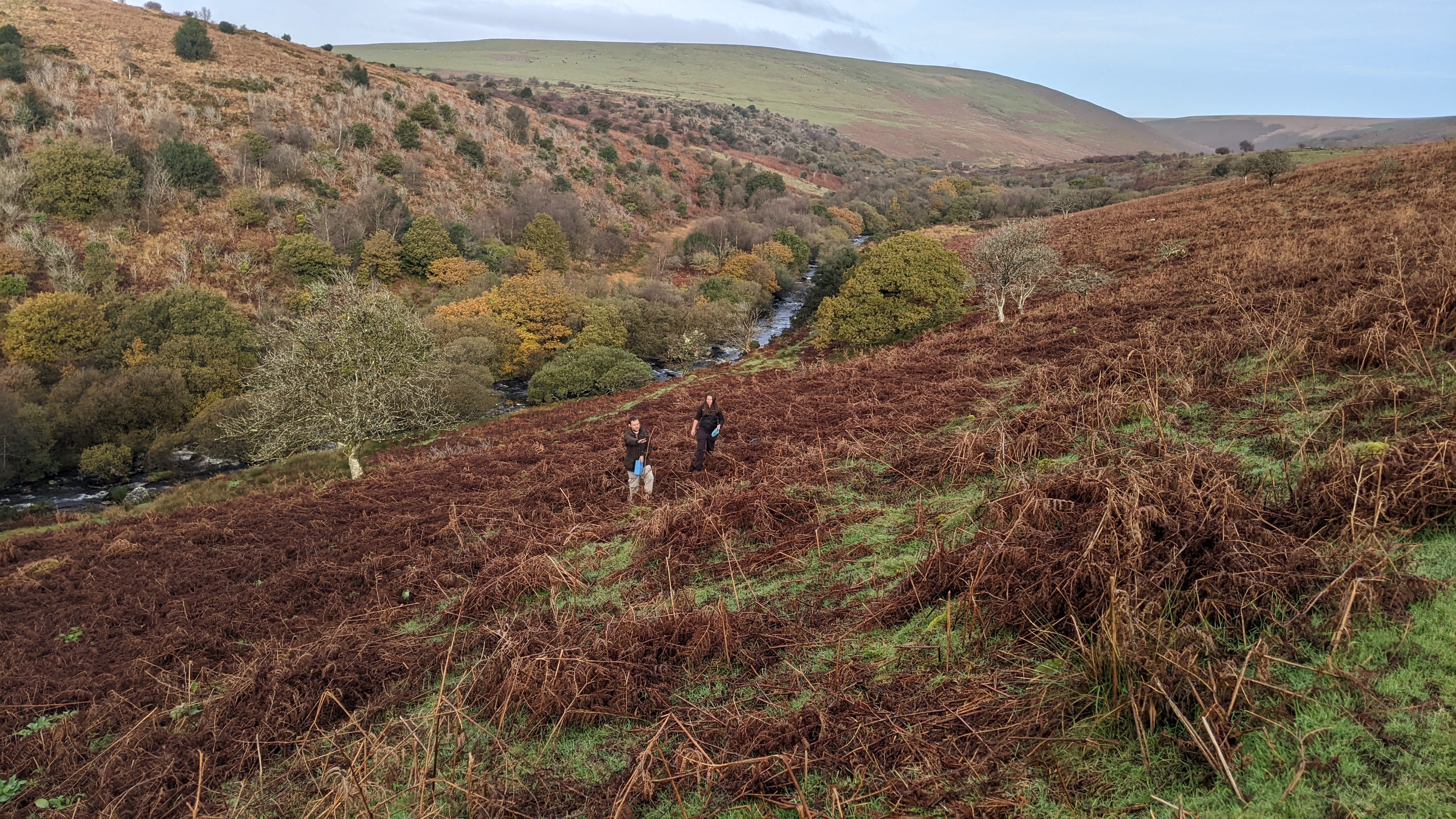 Piles Copse, both of which are temperate rainforests.
Planting in plots has been combined with scattered trees to blend into the landscape. These trees are protected with lightweight cactus guards, which are easier to install compared to traditional tree protection fences used in wood pastures.
By planting small tree plots and scattered trees, the project supports food production and environmental benefits; livestock can graze and access the river for drinking water.
Additionally, the trees will, in future, provide livestock with nutritious leaves, offer shade on hot days, and provide shelter during cold, rainy Dartmoor weather.
Better for Dartmoor
This initiative aligns with Dartmoor's Partnership Plan which targets an increase of 500 hectares of native woodland growth in river valleys.
More broadly, it's really exciting because the scheme is one of the first upland trials of this method in Europe and we have the University of Plymouth onboard to monitor the outcomes.
This work marks an innovative approach to managing the flow of water through Dartmoor, one with the potential to be modelled in other areas of the moor that could benefit from becoming a leafier landscape.
Article by Emily Tyack
8 October 2024